A new book on AI governance
Steering AI for Humanity
The Decision-Based Minimum Viable Legislation
Forthcoming from Atmosphere Press · Hardcover, paperback and ebook
The Decision-Based Minimum Viable Legislation
Forthcoming from Atmosphere Press · Hardcover, paperback and ebook
Every harm an AI can do reaches the world the same way. The AI decides, then it acts. Law can stand at that point, however powerful the model becomes.
Most proposals try to regulate what AI can do: its size, its compute, its benchmark scores. Those lines move every few months. This book takes the approach that human law has always taken with people. It judges the decision and holds someone accountable for it. A college student, a professor and a genius all follow the same laws. So can an AI system, whether it is today's model or a superintelligence.
From that starting point, decision science yields a short, complete set of rules: six AI mandates. They are minimum viable legislation, the smallest set of laws that covers the risk.
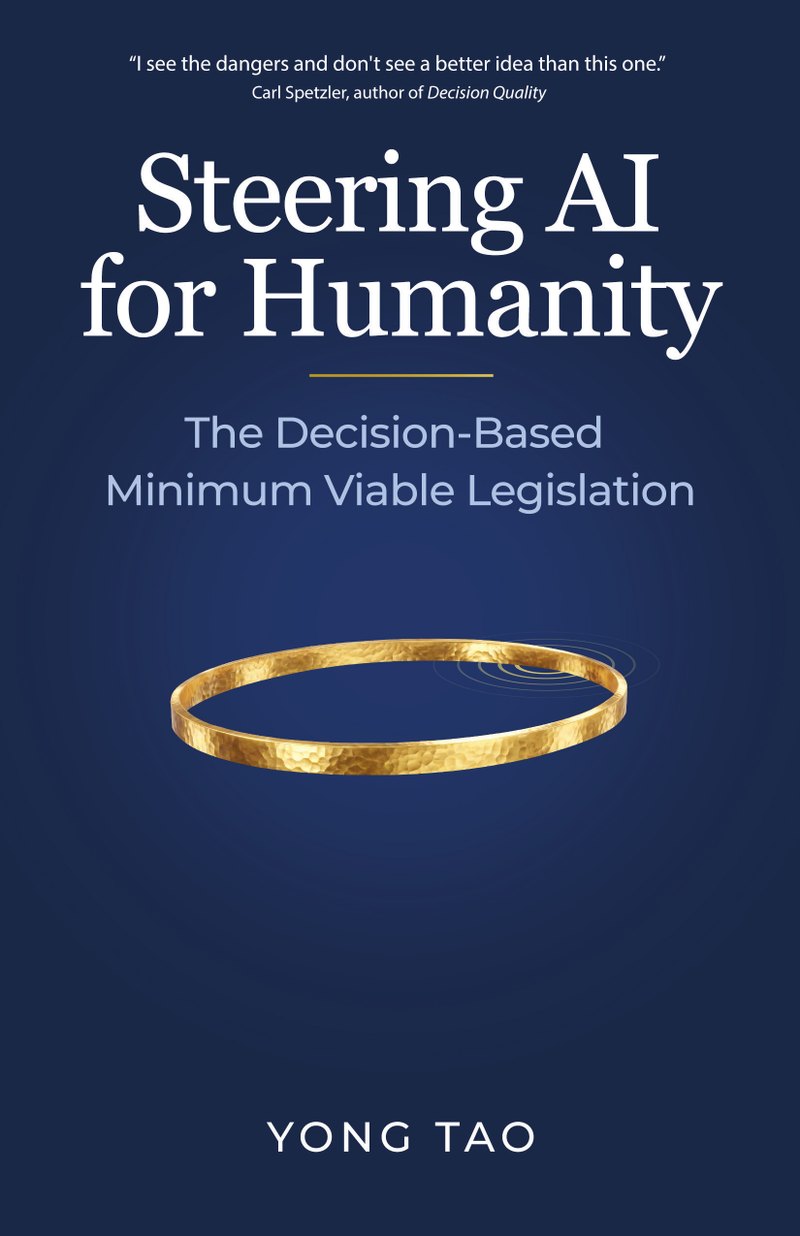
In Journey to the West, a monk steers a brilliant, unruly monkey king with a golden hoop around his head. The monkey keeps every power he has. The hoop tightens only when he goes wrong. The book uses that hoop as its picture of governance that steers AI without slowing it down.
Patchwork rules leave gaps. The book starts instead from five pillars that together cover every major area of AI risk. It then asks which pillars already have a governor. Markets reward products that serve their users well. Social policy handles the remaining risks, such as AI's effects on jobs and communities. Law is needed only for the three pillars in between, and those three yield the six mandates.
The first three work inside AI systems, at the moment of decision. The last three hold society's floor, so the first three cannot be undone.
AI complies with the ethics, laws and regulations of the country where it acts, checked at the moment of decision.
AI acts only with resources a human has authorized, and that human can revoke them.
A human can take over and steer AI at any time. Stopping it is the last resort.
AI is not a legal person. A human or company stands behind every AI decision.
AI holds no money, property or other assets in its own name.
AI does not hold public or corporate office.
“I see the dangers of AI and don’t see a better idea than this one to rein it in.”Carl Spetzler, author of Decision Quality

Yong Tao is a decision scientist and a Fellow of the Society of Decision Professionals. He earned his PhD at Stanford under the late Ronald A. Howard, who founded the field of decision analysis. His background spans control engineering, decision analysis and Silicon Valley.
He and Professor Howard began developing the decision-based approach to AI governance in 2022, before ChatGPT was released. He writes Govern AI Decisions on Substack and lives in Foster City, California. More of his work is at yongtao.ai.
The 12-page version of the argument, with the six mandates in their current order.
Read on SSRNPosts that read current AI bills and events through the decision lens.
Subscribe on SubstackTalks, briefings and the author's other work on AI governance.
Visit yongtao.aiFor interviews, speaking invitations or an advance reading copy, write to the author directly.